

Word Cookies! ®
BitMango
I first approached Word Cookies! ® expecting a simple word puzzle for filling a few spare minutes, and that is still one of its best uses. What surprised me was how clearly it builds a small, cheerful mood around a very familiar idea: letters sit in front of me, I rearrange them into words, and each solution gives the session a little forward movement. It is not trying to be a story-heavy adventure or a competitive language course. Its appeal comes from making ordinary spelling feel like a light game rather than a lesson.
That distinction matters. The game is free, made by BitMango, and belongs to the word-game corner of mobile gaming. It has reached over 50 million installs and holds a 4.5 average from around 2.3 million ratings, which fits my impression that it is designed for a broad audience rather than a narrow group of word-game experts. The age rating is Everyone, and the low barrier to entry is obvious from the first puzzle: I can start without learning a complicated ruleset, building a character, or understanding a large fictional universe.
The presentation supports that welcoming approach. The kitchen-and-baking theme gives the letter rearranging a recognizable identity, while the compact stages keep the experience easy to pick up. I would not call it visually ambitious, but it is coherent. The warm setting, playful word choices, and short puzzle rhythm all point in the same direction. Its strongest achievement is turning a basic anagram routine into a pleasant daily habit.
How the kitchen theme gives familiar word puzzles a personality
A friendly first impression instead of a demanding tutorial
The opening experience is intentionally approachable. I do not need to know anything about the developer’s other games, and I am not asked to commit to a long session. The central action is immediately understandable: inspect the available letters, find possible words, and use them to complete the current challenge. That simplicity makes the game suitable for a quick break, but it also means the early moments will feel very gentle to players who already spend time with anagram games.
The art direction helps prevent that gentleness from becoming completely anonymous. Rather than placing letters on a bare grid and leaving the theme to the background, the game frames progress through a baking-inspired setting. The visual language suggests preparation, ingredients, and completion, so solving a word feels connected to the surrounding presentation. I found that small connection useful because it gives each group of puzzles a little more character than a plain list of letter combinations.
Related News

Why WhatsApp Messenger Still Makes Everyday Communication Feel Easy

Jurassic World: The Game Is the Better Dino Tycoon for Strategic Players

Threads in Real Life: Who Should Join, Lurk, or Leave

How SHEIN Turned Shopping Into an Endless Content Feed

How to Make Fortnite Feel Smarter on Mobile

Should You Switch to Microsoft Outlook on Mobile?
There is no need to treat the theme as a deep world with lore to uncover. It works more like a wrapper that makes repeated word solving feel warmer. That is a sensible choice for a game people may open while waiting for transport, sitting with a coffee, or taking a short pause between tasks. A dramatic setting would probably distract from the core activity; this one stays in the background while still giving the game its own face.
The free entry point is another important part of that first impression. I can try the basic experience before deciding whether it deserves a place in my regular rotation. In-app purchases range from $0.99 to $99.99 per item, so anyone who enjoys the game should pay attention to purchase prompts and decide in advance whether optional spending fits their habits. For me, the sensible approach is to treat the free version as the test: play enough to see whether the repeated word-finding loop remains enjoyable before considering anything extra.
What the visual choices communicate
The baking motif gives the game a softer tone than many alternatives in the same category. A competitive word board can make every move feel like a contest, while a dictionary-style puzzle can feel almost academic. Here, the surrounding imagery makes progress seem more like preparing something small and satisfying. That does not change the underlying challenge, but it changes how the challenge lands emotionally.
Gallery
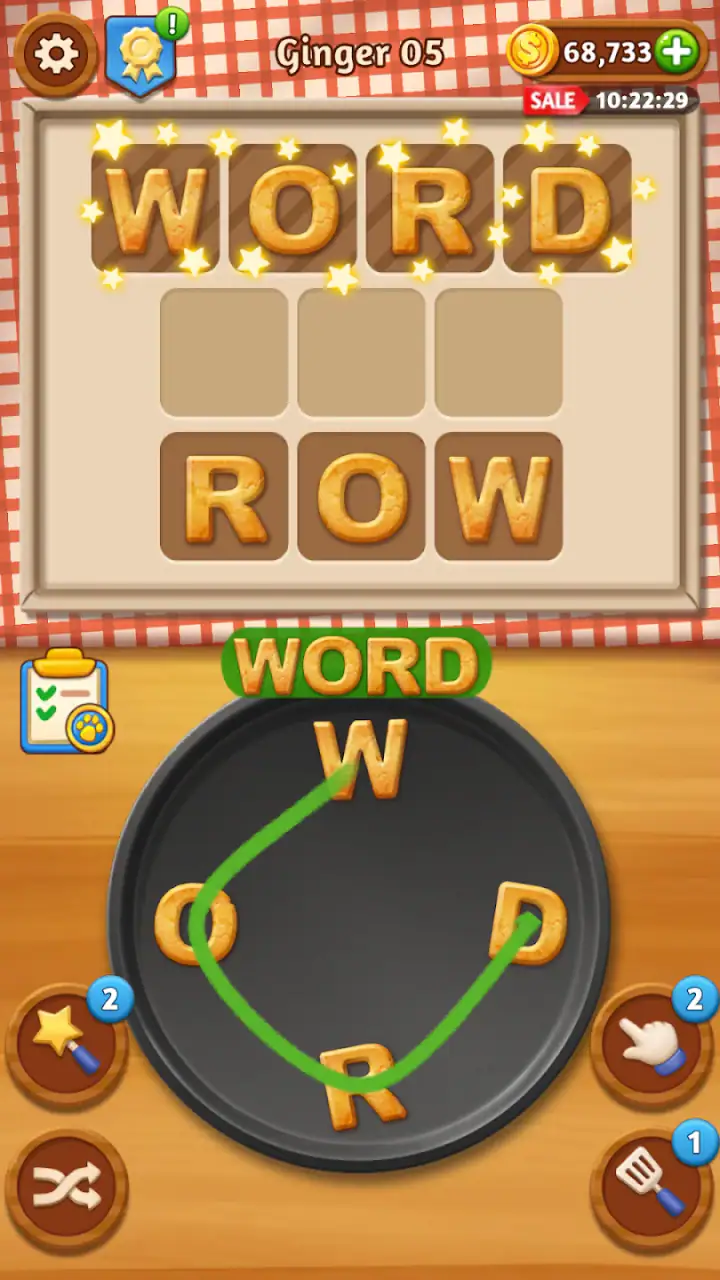
I also appreciate that the theme does not demand constant attention. When I am concentrating on a difficult arrangement of letters, the setting does not compete with the puzzle. When I solve a stage, the presentation gives the result a little more personality. This balance is easy to overlook, but it is one reason the game can remain relaxing even when a puzzle makes me pause.
The trade-off is that players looking for a strong visual identity may find the setting limited. The kitchen atmosphere is pleasant, yet it does not create the kind of discovery associated with a story game or a richly illustrated adventure. I would recommend it to someone who wants a mood around their word puzzles, not to someone choosing a game mainly for visual exploration.
Language as the real game world
In this title, words are not merely instructions for interacting with a world; they are the world. Every stage asks me to look at a small collection of letters from a new angle. That makes the game’s language design more important than its decoration. The satisfying moment is rarely the first obvious answer. It is the second or third word I notice after mentally rotating the same letters and testing a different arrangement.
This creates a useful kind of mental friction. I may recognize a familiar short word quickly, then overlook a longer one because my attention has settled too early. The game rewards stepping back and scanning again rather than tapping randomly. I have found that the best habit is to separate the process into two passes: first collect the words that appear immediately, then inspect the remaining letters for unusual combinations, endings, and shorter words hidden inside longer possibilities.
That method is especially helpful when I play while tired. Instead of treating a difficult stage as a test of instant vocabulary, I can make the search systematic. I look for common letter pairs, consider whether a word might be plural, and then revisit the unused letters. The game does not need to explain this strategy in detail; the structure naturally encourages it.
It is also worth understanding what kind of language practice this is. I may become quicker at spotting familiar spellings and more attentive to letter patterns, but this is not a substitute for a structured vocabulary course. The game’s goal is discovery and repetition, not definitions, grammar lessons, pronunciation, or guided progression through a language curriculum. Someone learning English from scratch may enjoy it as a supplement, but a dedicated learning app would be a better primary tool.
Why short words can be harder than long ones
One of the less obvious pleasures is that a tiny word can hold up progress more effectively than a long word. Longer answers often announce themselves because their letter pattern feels distinctive. Short answers are easier to miss because several combinations look plausible, and I can assume I have exhausted the possibilities too soon. When I get stuck, checking the smallest unused combinations is often more productive than staring at the longest arrangement.
This is also where the game can expose differences in personal vocabulary. A player who reads widely may recognize an answer immediately, while another player may need a hint or a slower search. That variation gives the puzzles some replay value as a mental exercise, although it can also make the experience feel less fair when the expected word is outside my everyday vocabulary.
I would not use the game to judge my intelligence. A missed answer may reflect familiarity, attention, or the simple fact that I am playing during a distracted moment. The better way to approach it is as a pattern-recognition activity. I can improve my process even when I do not instantly know every word, and that makes the game more encouraging than a strict spelling test.
Sound and rhythm during a short session
The audio presentation contributes to the same light atmosphere as the artwork. The game’s rhythm is built around small actions: inspect, form a word, receive feedback, and move onward. That sequence gives each successful answer a modest sense of completion. I do not need a dramatic soundtrack to understand that I am making progress; the compact feedback loop does much of the work.
For me, the most important audio question is not whether the sound design is spectacular, but whether it gets in the way during repeated play. A word game may be opened many times in one day, so exaggerated effects would become tiring quickly. The restrained approach suits the genre. I can focus on letters without feeling that every tap is being turned into a major event.
There is a practical trade-off here. Players who enjoy games mainly for rich music, voiced characters, or cinematic soundscapes will find little reason to choose this one over a more expressive genre. Its sound exists to support the puzzle rhythm, not to carry an emotional story. I see that as an appropriate limitation rather than a flaw, provided expectations are set correctly.
The pacing is similarly modest. Stages are small enough to make a few minutes feel productive, but the basic activity remains consistent. That makes the game comfortable for short sessions and less suitable for someone seeking constant mechanical variety. If I want a fast reset between responsibilities, the steady pace works. If I want a game that keeps introducing new systems, it may feel repetitive.
How the mechanics fit the mood
The central loop succeeds because the mechanics and presentation agree with each other. The game asks for concentration, but not the kind that creates pressure. I am solving one compact word challenge at a time, and the baking theme turns completion into a small reward. The result is a low-stakes puzzle experience that can be relaxing without becoming completely passive.
That fit is strongest when I use it as a transition activity. For example, after finishing work, I might play a handful of stages before starting dinner. The game gives my attention something specific to do, unlike scrolling through an endless social feed, but it does not demand the commitment of a long strategy session. Because the words are the focus, I can stop after a short run without feeling that I have abandoned a complicated objective.
Another useful scenario is travel or waiting time. If I have only a few minutes and do not want to begin a game that requires remembering a large map or a multi-step mission, this format is easier to enter. I can solve what is in front of me and close the app. That independence from a long narrative is one of its clearest strengths.
At the same time, the simplicity can expose repetition. Once I understand the rhythm, the novelty depends heavily on the letter sets and on my own willingness to keep searching. Players who prefer crossword clues, word definitions, or head-to-head competition may find more depth in those alternatives. A crossword asks me to use context and knowledge; a competitive board game asks me to manage position and scoring; this game concentrates on rearranging letters in a direct, approachable way.
That comparison helps identify the right audience. I would choose this over a crossword when I want less reading and a faster start. I would choose a crossword when I want clues to guide my thinking or teach me something through context. I would choose a competitive word game when I want social tension and strategic placement. None of those options makes the others obsolete; they satisfy different moods.
Practical ways to get more from the puzzles
My first tip is to avoid spending too long on one visual arrangement. Move the letters mentally rather than staring at them as a fixed row. I often find an answer after saying the possible sounds quietly in my head or grouping letters by familiar endings. This turns the task from random guessing into a repeatable search.
My second tip is to keep a mental distinction between discovery and confirmation. When I see a likely word, I submit it, but I do not assume the remaining letters are unimportant. A completed-looking group may still contain a short answer that I overlooked. Returning to the unused letters after every successful find is more efficient than waiting until the end and trying to solve everything at once.
My third tip is to use assistance thoughtfully rather than immediately. If I use a hint the moment I pause, I lose the chance to develop a better search habit. I prefer to give myself one deliberate second pass first: check short words, look for common endings, and reverse the order of the letters. If nothing appears, help can keep the session moving instead of turning a relaxing game into a frustrating contest with myself.
These habits also reveal a limitation. The game can encourage persistence, but it cannot guarantee that every answer will feel equally familiar or satisfying. When a word seems obscure, the pleasure of solving may be replaced by relief at moving forward. That is part of the genre’s unevenness, and it is a reason I would not recommend playing for long stretches if the challenge starts to feel like a chore.
Who should install it, and who should look elsewhere
I think it is a strong match for casual players who enjoy spelling, anagrams, and quiet progress. It is also a good choice for someone who wants a game that can fit around a busy day rather than organize the day around it. The Everyone rating makes it broadly approachable, although younger players may still benefit from an adult’s guidance around optional purchases and screen time.
It suits people who like gentle visual themes and a predictable loop. The kitchen setting adds charm without making the game complicated, and the word challenges can provide a useful concentration break. I can imagine recommending it to a friend who wants something more engaging than passive scrolling but less demanding than a full-length game.
I would be more cautious recommending it to players who need deep strategic systems, extensive story content, or a strong competitive layer. It is also not the best choice for someone seeking formal vocabulary instruction. A dictionary-based game may be better for learning meanings, a crossword may be better for clue solving, and a multiplayer word board may be better for rivalry.
Device compatibility is reasonably accessible for an older Android phone because the minimum operating system is Android 6.0. The current version is 26.0122.00, so keeping the app updated is sensible when possible. I would still judge the experience on the specific device and on personal tolerance for repeated prompts or optional spending, rather than assuming that a popular game will suit every player equally.
My atmosphere verdict after extended play
What stays with me is not a particular dramatic moment, but the consistency of the mood. The art, baking theme, sound, and pacing all support the same promise: sit down, look closely at a few letters, and enjoy a small feeling of progress. That coherence matters because the underlying mechanic is familiar. Without the setting and rhythm, the experience could feel like a plain anagram list.
The game is at its best when I treat it as a compact ritual. A few puzzles during a break can sharpen my attention and give me a satisfying finish. Longer sessions are possible, but the repeated structure becomes more noticeable, and players who need constant novelty may lose interest. The free price makes trying it straightforward, while the range of optional in-app purchases means I would keep spending under conscious control.
BitMango has built a word game that understands its own scale. It does not need a complicated world to make letter rearranging inviting. Instead, it uses a friendly kitchen atmosphere and a steady rhythm to make familiar mechanics feel comfortable. If you want a relaxed word game with a clear visual mood and quick, self-contained challenges, I would recommend giving it a try.
My final recommendation is therefore positive but specific. Choose it for short, low-pressure sessions, casual spelling practice, and the satisfaction of finding one more hidden word. Skip it if your priority is a rich narrative, advanced strategy, formal language teaching, or competitive play. For the right player, its modest ambition is exactly what makes it work: it creates a pleasant little space where language, sound, and simple puzzle pacing fit together without asking for more time than you want to give.
FAQs for Word Cookies! ®
What is Word Cookies! ® and how does it work?
Word Cookies! ® is a fun and addictive word puzzle game where players are challenged to find hidden words using a set of given letters. The goal is to swipe the letters to form as many words as possible, advancing through levels with increasing difficulty. It’s perfect for those who enjoy word games and want to improve their vocabulary.
Is Word Cookies! ® free to play?
Yes, Word Cookies! ® is free to download and play. However, it does offer in-app purchases for hints and other game enhancements. While these purchases can enhance the gaming experience, they are not necessary to progress through the levels, making the game accessible for all players.
What platforms is Word Cookies! ® available on?
Word Cookies! ® is available on both Android and iOS platforms. You can download it from the Google Play Store for Android devices or the Apple App Store for iOS devices. Ensure your device meets the minimum system requirements for smooth gameplay.
Can I play Word Cookies! ® offline?
Yes, Word Cookies! ® can be played offline, which makes it convenient for users who want to play on the go without an internet connection. However, some features, such as updates and certain in-app purchases, may require an internet connection.
Are there any ads in Word Cookies! ®?
Yes, Word Cookies! ® includes ads, which appear periodically during gameplay. These ads help keep the game free for players. If you find the ads intrusive, there is an option to purchase an ad-free version through in-app purchases, allowing for uninterrupted gameplay.
Pros
- Engaging word puzzles boost vocabulary.
- User-friendly interface enhances gameplay.
- Wide variety of levels for all ages.
- Frequent updates keep content fresh.
- Offline mode available for on-the-go fun.
Cons
- In-app purchases can be costly.
- Ads may interrupt gameplay frequently.
- Hints can run out quickly
- frustrating.
- Some levels feel repetitive over time.
- No multiplayer mode for social play.


